An exploration of chain tales, especially cumulative tales, plus related formula tales with a focus on children's books you can read and/or listen to online.
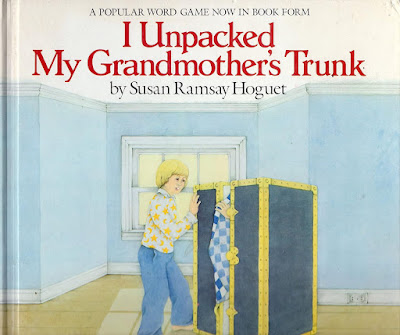
I Unpacked My Grandmother's Trunk: A Picture Book Game is a children's book by Susan Ramsay Hoguet, with art by the author, published in 1994. It is available at the Internet Archive.
The book opens with instructions for how to play the "Grandmother's Trunk" game, which is a cumulative alphabet game. The author suggests using the A-Z list in the book as the basis for a game, memorizing the objects that come out of this grandmother's trunk. The chain is cumulative, and so are the illustrations!
an acrobat, a bear, a cloud, a dinosaur, an eagle, a fairy, some grass,
a hat, an igloo, a jungle, a kangaroo, a lamp, a mouse, a nest, an ostrich, a pagoda, a queen, a rocking chair, a snowman, a tiger, an umbrella, a valentine, a windmill, a xylophone, a yo-yo, and a zebra
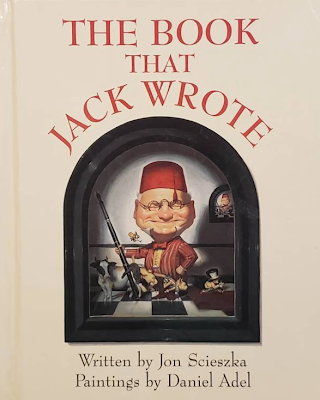
The text of this book plays with the traditional "Jack" story by starting out with the initial cow-dog-cat-rat series, but then things become more whimsical, inspired by other nursery rhymes and literary figures... and then, a man in a "tattered" coat shows up (echoing the man "tattered and torn" from the traditional Jack... and that man IS Jack. You can see how it all fits together as the chain concludes; note the rhyming couplets:
This is the Book that Jack wrote, That squashed the Man in the tattered coat, That stomped the Bug,
That frayed the rug,
That tripped the Hatter in the hall,
That knocked the Egg falling off the wall,
That startled the Pieman at the fair,
That flung the Pie flying through the air,
That beaned the Baby humming the tune,
That tossed the Cow sailing over the moon,
That spooked the Dog,
That chased the Cat,
That ate the Rat,
That fell in the Picture...
That lay in the book that Jack wrote.
The artwork is whimsical in a way that suits the story very nicely:
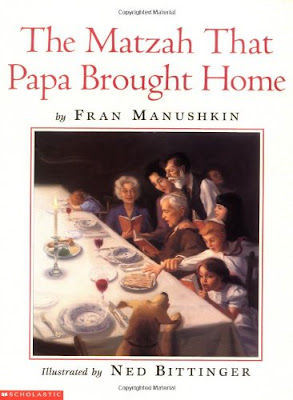
The Matzah That Papa Brought Home is a children's book by Fran Manushkin, with art by Ned Bittinger, published in 1995. It is available at the Internet Archive.
Like the traditional "Jack," the story does not start out with rhymes, but it soon shifts into rhyme, specifically, rhyming couplets, as it narrates the elements of a Passover seder in order, with realistic illustrations:
Here is the end of the chain; as you can see, it is a purely temporal chain, listing one thing after another after another, in the order of the Passover ritual:
FINALLY, "NEXT YEAR IN JERUSALEM!" WE SAID, then everyone hugged, and went to bed, after the door was opened wide inviting Elijah to step inside after the afikoman was found by searching the house and running around, after the matzah ball soup that we sipped after the bitter herbs that we dipped after "Dayenu," a very long song that we sang with our stomachs growling along after we counted the plagues - all ten — by dipping our pinkies again and again after I stood up tall and proud and asked the Four Questions nice and loud during the Passover Seder we shared to eat the feast that Mama made with the matzah that Papa brought home.
I said the images were realistic, but there are frogs and locusts for the recitation of the plagues:
Then, after the end of the chain, there is one last rhyming couplet, and then another two lines including stories and matzahs, plus mamas and papas:
NOW THE PASSOVER MOON SHINES ITS BEAMS, bringing the children of Israel sweet dreams... and we will remember the stories and matzahs our mamas and papas brought home.
I really like this self-reflexive page at the end, where a character is looking at himself in the book looking at himself in the book, and so on!
In the very back of the book there are some informational pages which tell "The Story of Passover."