Showing posts with label World: Africa. Show all posts

Friday, August 30, 2024

Kurtz. Trouble

Trouble is a children's book by Jane Kurtz, with art by Durga Bernhard, published in 1997. It is not available at the Internet Archive, but there is a YouTube read-along by the author!


After two cranky posts about Benjamin Elkin's appropriation of African folktales while providing no acknowledgement of his sources, I am so pleased to write about this beautiful book which provides abundant information about how this story came to be, along with artwork that is far more culturally responsive than the art in Elkin's books. Children's book publishing has come a long way in the 30 years that separate Kurtz's book from Elkin's.

In the detailed author's note, Kurtz explains that she heard this story about the boy and his gebeta board when she was growing up in Ethiopia. She also notes that Courlander collected a version of this story in Eritrea (back in the 1940s, when it was still part of Ethiopia; see this post), so based on that, she decided to set her version of the story in Eritrea. In addition to the author's note, there is a glossary of the words used in the story that might not be familiar to Anglo readers: dik-dik, gebeta, injera, mashella, and masinko, along with the meaning of the name of her protagonist, the boy she named Tekleh.

The book has been published not just in English but also in several eastern African languages: Amharic, Tigrinya, Swahili and Oromo. How cool is that? Listen to the end of the video when the author's sister, who lives and works in eastern Africa, reads the start of the story in Amharic (with an American accent, as she freely admits!).

In Kurtz's version of the folktale, which starts out very similar to the version that Courlander heard in the 1940s but then goes in a new direction, a man makes a gebeta board for his son to try to keep him out of trouble. When Tekleh meets a camel caravan, the traders complain that there is no wood in that country to make a fire, and when Tekleh insists there is wood and shows them his gebeta board, they throw it into the fire. In compensation, they give him a knife. A hunter needs a knife to skin a dik-dik, and Tekleh trades the knife for a masinko (musical instrument). He meets some musicians on their way to a wedding feast and trades the masinko for a drum, and follows them to the wedding where he snatches some food. He then plays his drum for a farmer (the noise keeps birds and monkeys away), who rewards him with corn. Then he gives the drum to the farmer for a papaya. He meets a woman whose children are hungry and gives them the corn and the papaya. One of the children gives him a gebeta board, and when he returns home, his father says, "Did I not tell you? A gebeta board never fails to keep a young boy out of a trouble."

As you can see, this is a story of trades more than a story of compensation; in Courlander's story, and in Elkin's version also, people break or lose the object that the boy gives them, so they cannot return it to him and must give him some kind of compensation. (This compensation story is found in trickster versions also; I'll have examples of those to share later.) In Kurtz's story, however, Tekleh is very good-hearted and kind, and in the end he even gives the corn and papaya to the hungry family without even thinking of something in return... which is when, in fact, he gets back the gebeta board he lost in the fire to begin with. I've marked this as a "compensation" type of story because it starts off that way, but it really is more of a generic "trading" type of chain tale — not trading-up or trading-down because, ultimately, it is trading in a circle!

Although there is not an illustrator's note (that is my ideal: an author's note AND an illustrator's note!), the book jacket explains that Bernhard "teaches West African drum and dance. As research for this book she played the gebeta game with her children and learned to cook Eritrean food." As you can see in the YouTube video, the illustrations are absolutely lovely, far more culturally responsive than the illustrations in Elkin's book.

So, if like me, you are a collector of chain tale books and/or African folktales for children, this is a book you will want to add to your collection!

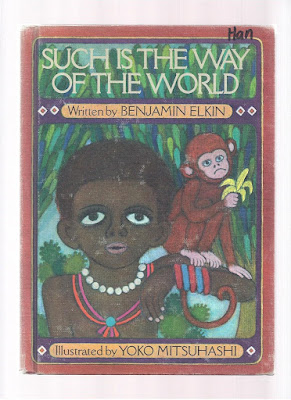
Elkin. Such Is the Way of the World

Such Is the Way of the World is a children's book by Benjamin Elkin, with art by Yoko Mitsuhashi, published in 1968. It is available at the Internet Archive.

In Elkin's story, a little boy named Desta and his pet monkey Jima are tending cattle, but a dog barks and scares the monkey away, and the cattle bolt, but all Desta wants is his monkey. The dog's owner gives him a gameboard to compensate for the lost monkey, but he keeps looking for his monkey. He finds some camel-drivers, but he stumbles on one of their saddles and drops the gameboard in the fire. As compensation, they give him a pot. He meets some warriors; one warrior takes his pot to use as a drum but when he drums on the pot, it breaks; he gives Desta ostrich feathers as compensation. A woman merchant uses the feathers as a fly whisk but the wind carries them away; she gives him a knife as compensation. A goatherd borrows the knife to dig but breaks it on a stone; he gives rope as compensation. An old man uses the rope to try to fish out his canteen from a well, but he drops the rope; he gives a spear in compensation. A hunter takes the spear to kill a lion, but the spear snaps; he gives Desta a monkey he just caught as compensation... it is Jima! But what about the cattle? He runs home to see the cattle already heading home on their own without him. The father is happy and says he is glad they gave Desta a pet monkey because "There is nothing like a nice pet to keep a boy's mind on his work."

Elkin is also the author of Why the Sun Was Late, which, like this book, is based on an African folktale and, once again, Elkin does not credit his source or indicate the cultural tradition to which it belongs. The name of the boy, Desta, suggests that this is an Amharic folktale from Ethiopia, and the gameboard looks like an Ethiopian gabata board, so presumably the source was Ethiopian... but why doesn't Elkin tell us that? 

Time for some detective work! A likely published source for an Ethiopian folktale in 1968 would be Courlander and Leslau's anthology of Ethiopian stories, The Fire on the Mountain, first published in 1950 (and then later reissued under a new title — The Fire on the Mountain, and Other Stories from Ethiopia and Eritrea — after Eritrea gained its independence from Ethiopia in 1991).... and sure enough, here it is: The Game Board. This version is also a circular story, starting with a father who carves a gebeta board for his son, but the son then loses it through a series of misadventures although he ultimately gets another gebeta board in the end, so when he goes home to his father, his father, not suspecting all the intervening adventures, says, "What is better than a gebeta board to keep a small boy out of trouble?" About the story, the authors provide this helpful note, so we know that it is an Eritrean story:

THE GAME BOARD: Heard by Harold Courlander in the village of Amhur, about thirty-five kilometers south of Asmara, Eritrea. Central African versions, as well as European and West Indian, exist, but the sly humor of the ending of the Ethiopian tale is a local product. Gebeta is an Ethiopian form of a kind of African checker game played on a board, or set of boards, with carved holes or pockets.

So, there we go! It looks like Elkin has kept the circular structure, but instead of focusing on the game board, he has focused on the monkey. Or maybe there is some other Ethiopian folktale out there with the pet monkey? I don't know... because Elkin chose not to tell us. In the version Courlander heard, the sequence of exchanges is game board to knife to spear to horse to ax to wood to game board, so that is not the same as in Elkin, but the father's remark at the end makes me feel like this must be based on the version Courlander heard, but freely altered by Elkin.

Still, there's no way to know for sure, so I'll be on the lookout for other versions of this story to see what I can learn.


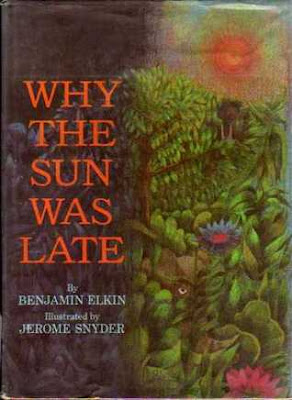
Elkin. Why the Sun Was Late

Why the Sun Was Late is a children's book by Benjamin Elkin, with art by Jerome Snyder, published in 1966. It is available at the Internet Archive.

A fly alights on an old tree and it falls; this makes the fly proud, and he decides to push TWO boys out of another tree where they are gathering nuts. Angry, one of the boys pushes the fly away; the fly hits a branch where THREE squirrels were sitting; they fall down on FOUR snakes. They slither away into a herd of FIVE elephants. The stampeding elephants crash into a tree, knocking down a nest that contains SIX eggs. The mother bird cries, saying she will never sing again. Because she did not sing in the morning, the sun did not rise. The animals called to the Great Spirit for help, who asks the bird what's wrong; "my six eggs were broken by those five elephants," and so back on down the chain. All the fly coul say was "buzz buzz." Because the fly would not speak up and explain, the Spirit punished the fly so that he would never speak again and only "buzz." Then he makes the bird's eggs whole egg and tells her to go to her nest and sing, and back on down the chain: the elephants returned to the field, etc. 

This is obviously based on an African folktale (for another story of this type, see "Why the Bush-Fowl Calls Up the Dawn" where the god is named Obassi, the supreme deity of the Ekoi people; see also Aardema's very popular Why Mosquitoes Buzz), but the author gives no indication as to the specific source that he used or the cultural tradition to which that source belongs. It really bugs me when people do not at least acknowledge their source! I'm pretty sure that turning it into not just a chain of accidents but a chain of numbers is the author's addition (I have not seen an African chain tale that plays a number game like this), but again, I am just guessing, and I have to just guess because the author has not provided any kind of commentary on the story. Argh. 

For another unattributed African folktale by Elkin, see Such Is the Way of the World.


Saturday, August 24, 2024

Martin. The Honey Hunters

The Honey Hunters is a children's book by Francesca Martin, with art by the author, published in 1992. It is available at the Internet Archive

The story is wonderful: a boy follows a honeyguide in search of honey and accumulates animal companions along way: rooster and bush-cat, antelope and leopard, zebra and lion, plus an elephant. 

There is not a cumulative style as the companions assemble, but all the elements in the chain are repeated at the end, specifically in pairs: the boy breaks the honeycomb into four parts, one part for each pair, but then the pairs start fighting. Rooster and bush-cat fight, antelope and leopard, zebra and lion, plus the elephant who takes the whole piece for himself. The boy tells everybody to stop fighting, but it's too late: now rooster is now always at odds with bush-cat, elephants at odds with humans, etc.

The artwork is one of the best features of this book; the animal drawings are beautiful and expressive, and there are also many animals depicted who are not part of the story... but they could have been, and those extra animal illustrations could be used as a prompt for young storytellers to expand on the story and extend the chain.

In a tiny note at the beginning of the book, Martin says that the story is a traditional folktale of the Ngoni people, but that is all; she does not tell readers about where the Ngoni live in Africa or about her actual source, nor does she explain just what a honeyguide bird is and does. Martin is also the author of Clever Tortoise, another book based on an African folktale that she published some years later, and in that book she does an excellent job of explaining her connection to the story, as you can see in the screenshot below; I wish she had done something similar to The Honey Hunters. In that book, she also uses Swahili names for the animals, which would have been a fine option for this book too!