Such Is the Way of the World is a children's book by Benjamin Elkin, with art by Yoko Mitsuhashi, published in 1968. It is available at the Internet Archive.
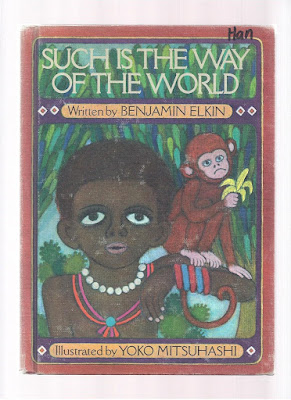
In Elkin's story, a little boy named Desta and his pet monkey Jima are tending cattle, but a dog barks and scares the monkey away, and the cattle bolt, but all Desta wants is his monkey. The dog's owner gives him a gameboard to compensate for the lost monkey, but he keeps looking for his monkey. He finds some camel-drivers, but he stumbles on one of their saddles and drops the gameboard in the fire. As compensation, they give him a pot. He meets some warriors; one warrior takes his pot to use as a drum but when he drums on the pot, it breaks; he gives Desta ostrich feathers as compensation. A woman merchant uses the feathers as a fly whisk but the wind carries them away; she gives him a knife as compensation. A goatherd borrows the knife to dig but breaks it on a stone; he gives rope as compensation. An old man uses the rope to try to fish out his canteen from a well, but he drops the rope; he gives a spear in compensation. A hunter takes the spear to kill a lion, but the spear snaps; he gives Desta a monkey he just caught as compensation... it is Jima! But what about the cattle? He runs home to see the cattle already heading home on their own without him. The father is happy and says he is glad they gave Desta a pet monkey because "There is nothing like a nice pet to keep a boy's mind on his work."
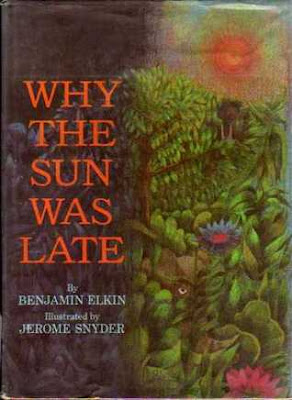
Elkin is also the author of Why the Sun Was Late, which, like this book, is based on an African folktale and, once again, Elkin does not credit his source or indicate the cultural tradition to which it belongs. The name of the boy, Desta, suggests that this is an Amharic folktale from Ethiopia, and the gameboard looks like an Ethiopian gabata board, so presumably the source was Ethiopian... but why doesn't Elkin tell us that?
Time for some detective work! A likely published source for an Ethiopian folktale in 1968 would be Courlander and Leslau's anthology of Ethiopian stories, The Fire on the Mountain, first published in 1950 (and then later reissued under a new title — The Fire on the Mountain, and Other Stories from Ethiopia and Eritrea — after Eritrea gained its independence from Ethiopia in 1991).... and sure enough, here it is: The Game Board. This version is also a circular story, starting with a father who carves a gebeta board for his son, but the son then loses it through a series of misadventures although he ultimately gets another gebeta board in the end, so when he goes home to his father, his father, not suspecting all the intervening adventures, says, "What is better than a gebeta board to keep a small boy out of trouble?" About the story, the authors provide this helpful note, so we know that it is an Eritrean story:
THE GAME BOARD: Heard by Harold Courlander in the village of Amhur, about thirty-five kilometers south of Asmara, Eritrea. Central African versions, as well as European and West Indian, exist, but the sly humor of the ending of the Ethiopian tale is a local product. Gebeta is an Ethiopian form of a kind of African checker game played on a board, or set of boards, with carved holes or pockets.
So, there we go! It looks like Elkin has kept the circular structure, but instead of focusing on the game board, he has focused on the monkey. Or maybe there is some other Ethiopian folktale out there with the pet monkey? I don't know... because Elkin chose not to tell us. In the version Courlander heard, the sequence of exchanges is game board to knife to spear to horse to ax to wood to game board, so that is not the same as in Elkin, but the father's remark at the end makes me feel like this must be based on the version Courlander heard, but freely altered by Elkin.
Still, there's no way to know for sure, so I'll be on the lookout for other versions of this story to see what I can learn.